Annotation
Annotation is an Optional Feature of BOVS Diagrams. It allows you to label Arrows to be more specific about the relationships they represent.
Appearance

Annotations are text labels that appear alongside Arrows. They may appear at the start, middle or end of the Arrow; whatever is unambiguous and the clearest in each situation (this is usually the start).
Interest Arrows
Where the relationship is an interest, the annotation label is written in a standard way:
- The nature of interest is given in the active voice, e.g. “Owns” or “Controls”
- The strength of interest is given as a percentage, e.g. “10%”.
Annotations respect the Chirality rule, that is:
- Annotations about ownership appear on the left/below Arrows
- Annotations about control appear on the right/above Arrows
Relationship Arrows
Where the relationship is not an interest, the annotation label should be written in the active voice. For instance, an Arrow connecting a mother and daughter, which proceeds from the mother to to the daughter, would mean “is the mother of”, and could be labelled “Mother”.
You might also choose to use an icon instead of text, in which case you should include a key.
Non-interest annotations can be written on either side of the Arrow.
Detail Level
Interest Annotations across your diagram must use a consistent detail level. Annotations may either qualify interests or additionally quantify them. In most cases, you should prefer to provide full detail, that is, to quantify interests.
Qualifying Interests
Annotations indicate if the nature of interest is ownership, control or both; but they do not indicate the strength of interest.

If your diagram also has an Interest Focus, omit all annotations except those to mark Unknown or Unquantifiable interests (see below).
Quantifying Interests
Annotations additionally indicate the strength of ownership or control.

If your diagram also has an Interest Focus, omit the nature of interest and write the strength (percentage) only.

Relevance
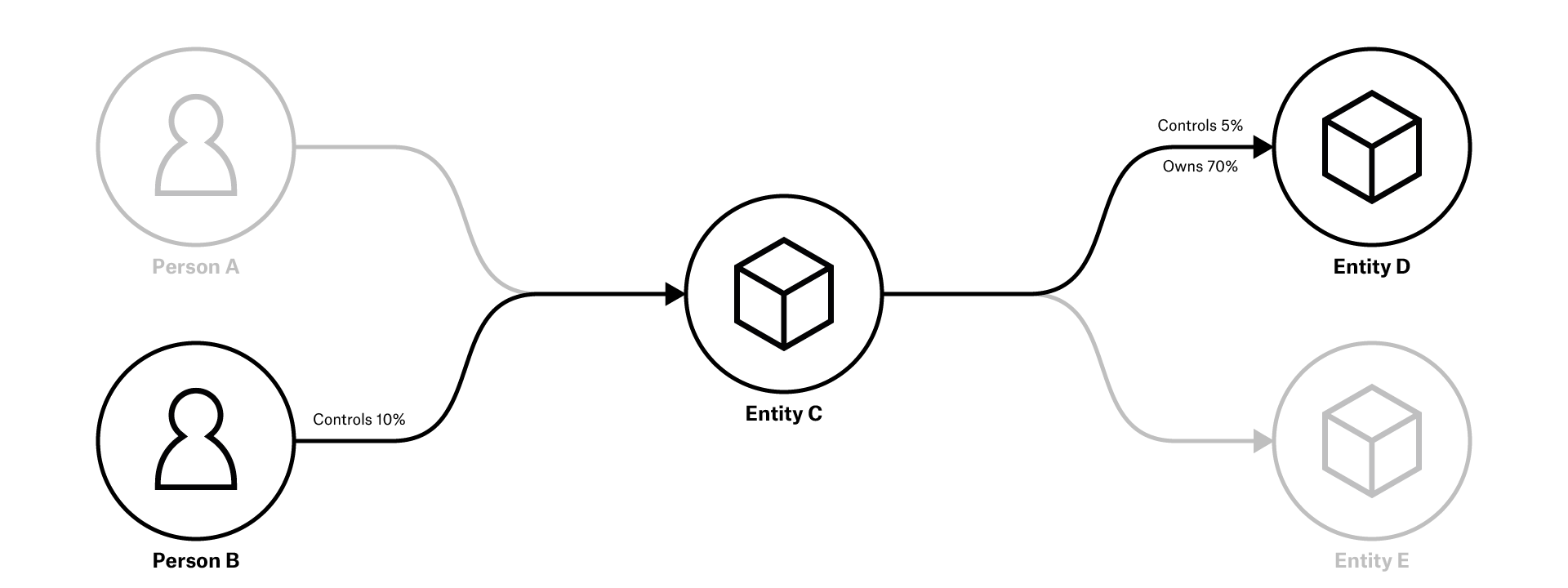
All relevant interests in your diagram must be annotated.
- Annotations should not be added to non-relevant interests.
- Omission of an annotation (of a relevant Arrow) means absence of interest.
- e.g. if there is no annotation on the side of the Arrow where ownership information appears, it means there is no ownership interest.
Indirect Arrows

You may choose to add interest Arrows that connect distant Parties, and annotate these. These are Indirect Arrows.
- Indirect Arrows are drawn with a dotted or dashed line.
- This Arrow must be annotated with the compounded interest of the first Party in the last.
Stacks
If a Stack appears at a Node you are considering to be relevant, you must annotate the Node with a summary of the interests within the Stack. This ensures the interest flow along the Chain remains clear.
Where an Entity Stack appears along a relevant Chain:
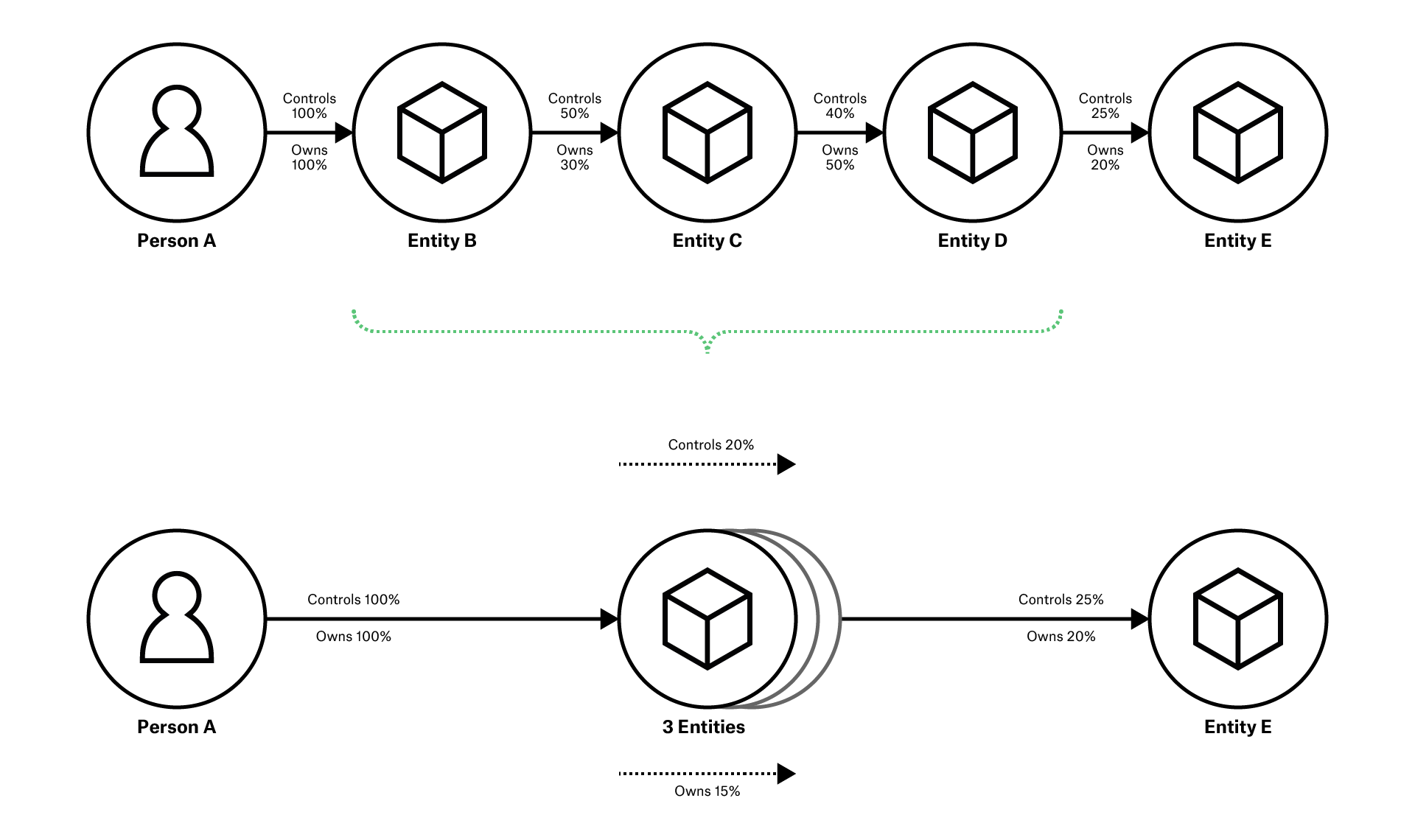
- Add a disconnected Indirect Arrow, floating beside the Entity Stack, parallel to the Arrows leading into/out of it.
- Add an Arrow for each nature of interest present inside the Stack (i.e. ownership or control).
- Add these Arrows on the appropriate sides of the Node, respecting the Chirality rule.
- Label these Arrows with the compounded interests of the Parties within the Stack.
Where a Owner Stack appears along a relevant Chain:
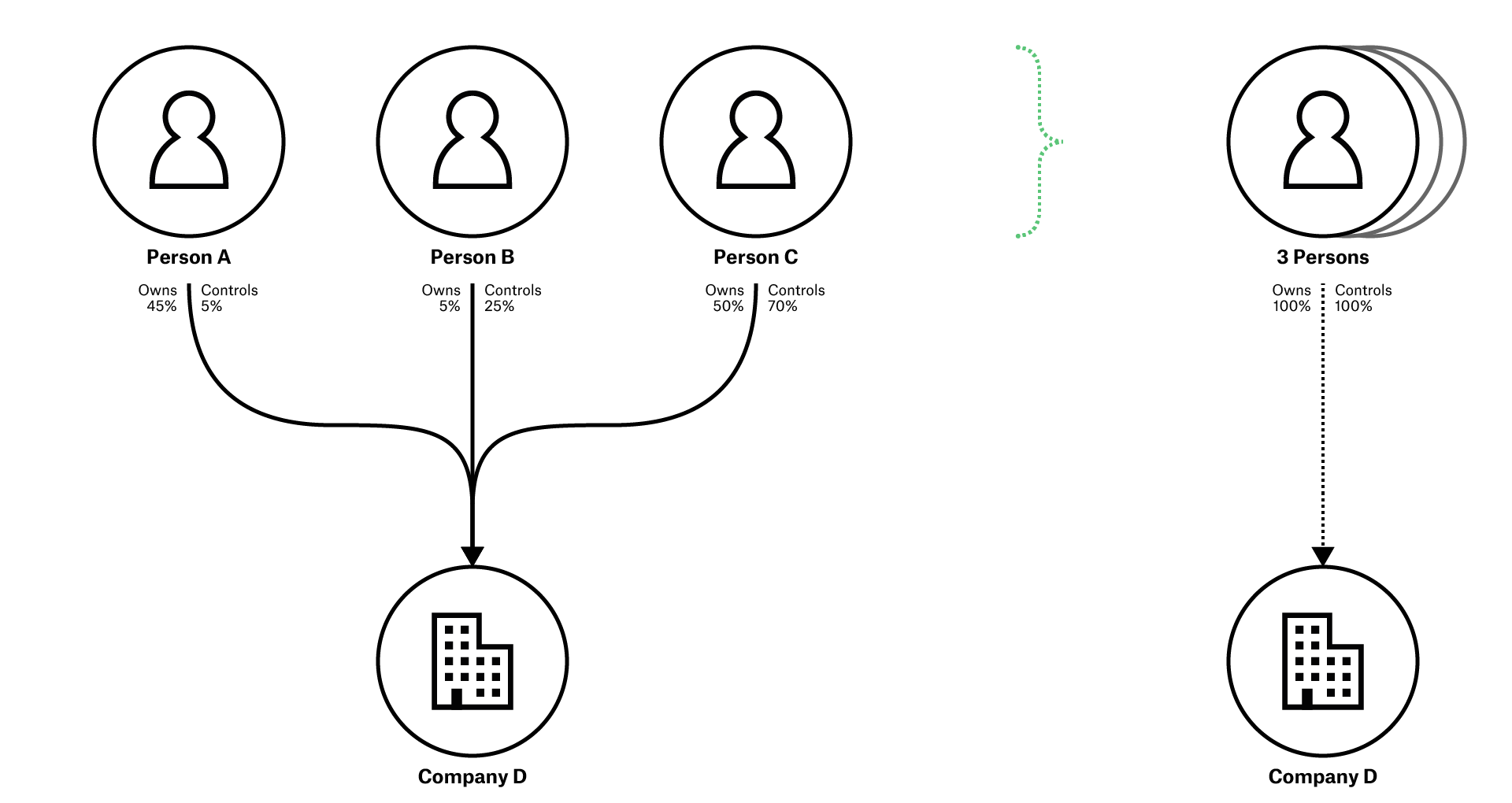
- Draw the Arrow from the Owner Stack as an Indirect Arrow (see above).
- Label this with the combined interests of the Parties in the Stack.
Obscured Interests
Unknown Nature
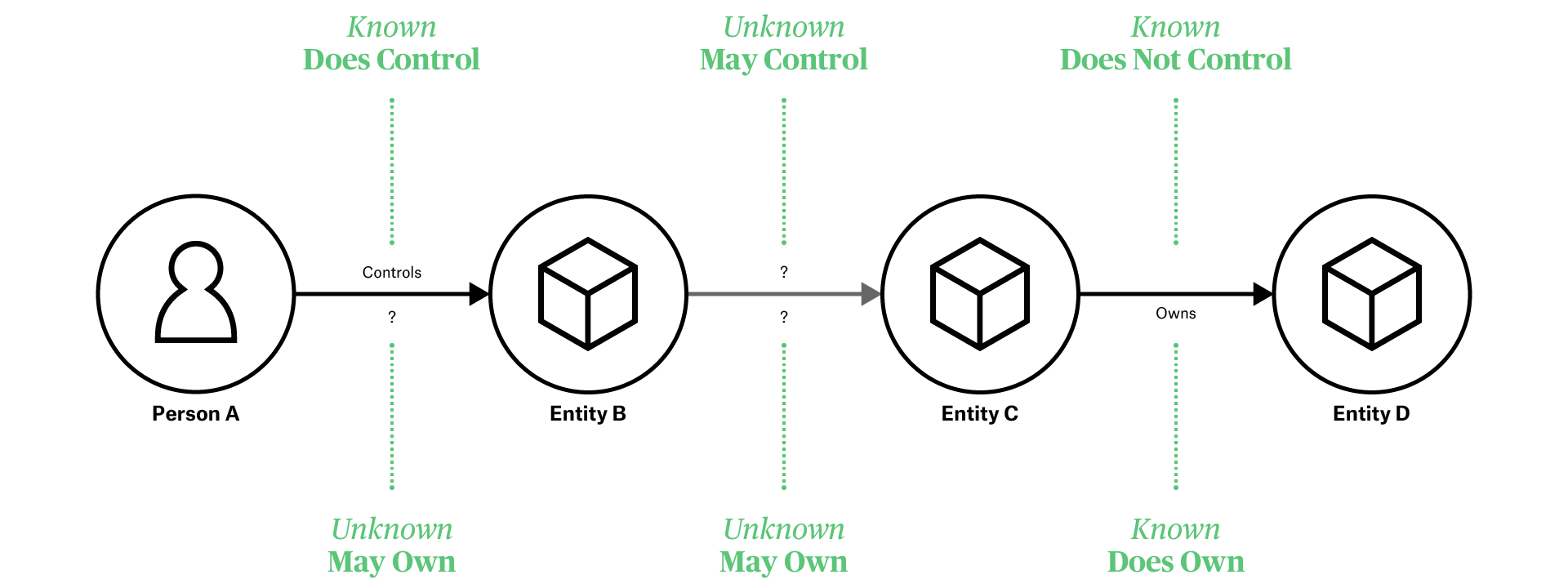
If the nature of interest is unknown:
- Write ‘?’ on the appropriate side of the Arrow, respecting the Chirality rule, if it is not known whether the interest includes control, or it is not known whether the interest includes ownership.
- If the nature of interest is completely unknown, write a ‘?’ on both sides of the Arrow.
Unknown Strength

If the strength of interest is unknown, and you are quantifying interests:
- Write ‘?%’ on the appropriate side of the Arrow.
- Don’t skip the ‘%’. Otherwise it looks like the nature is in question, not the strength.
Uncertain Strength

If the strength has uncertainty in it:
- Write a percentage range, e.g. “Owns 10-15%”, “Controls 50-100%”.
Unquantifiable Interest
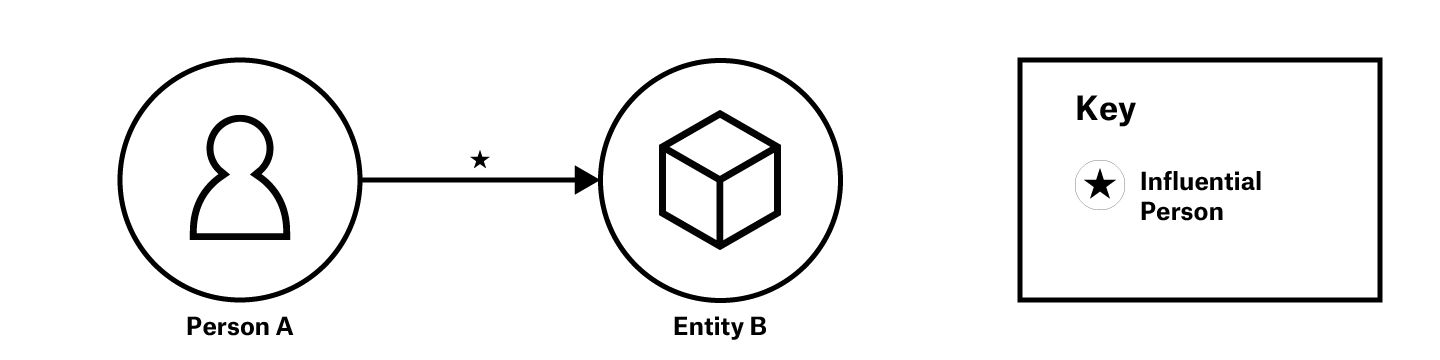
If there is an unquantifiable interest:
- In place of a textual annotation, or alongside one, show an icon.
- Use a different icon for each type of unquantifiable interest in your diagram.
- Include a key in your diagram offering information about each type of unquantifiable interest.